Considerations For Designing a Program With a Circularity Twist
Here are some considerations for designing a program with a circularity twist:
Understand the stage of development of the ventures and the challenges they are experiencing to create targeted problem-focused support.
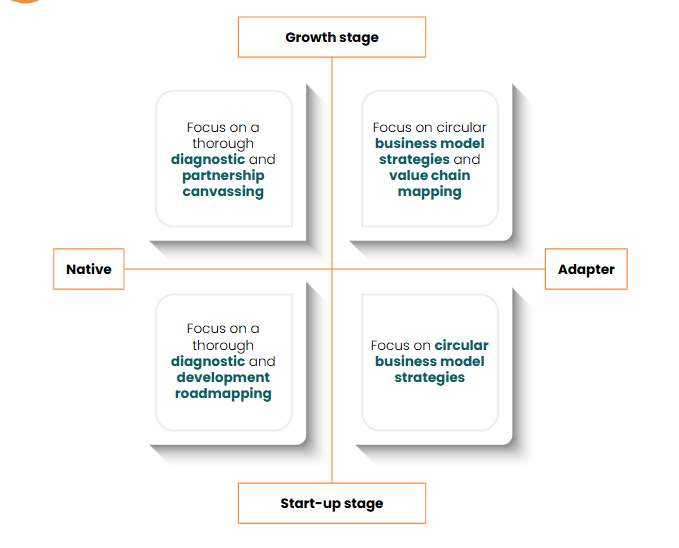
The diagram overleaf offers an overview of the kind of support that typically suits a venture based on its development stage and circularity status. This is a very high level but offers an example of how support can vary based on two considerations.
What do you want to achieve with the ventures or the value chain at the end of the program? Do you envision a showcase to a particular audience at the end of the program? What outcomes do you want to see in your program participants and ecosystem?
Conduct a diagnostic exercise that includes Circular Economy questions in order to identify problems, goals and support needs.
Support prototyping, piloting and other validation activities to test solutions in real situations. Encourage ventures to test as soon as possible
Include on-site visits to partners in the value chain to get to know each other better. A variation could be to have all ventures invite one to three (potential) value chain partners they would like to work with (more) to an event.
Include live (online or in-person) meetings with experts and stakeholders. Don’t forget to include a speaker or trainer fee and space and catering in your budget for these meetings.
Include a practice pitch event with an audience of experts, mentors or partners, for feedback a few weeks before the final event. This way program participants may already get valuable tips and connections and the final presentation will improve.
Impact Hub Amsterdam outlines five ways to embed circularity into startups in this article. Ask yourself how your program can address these recommendations and what this might look like in practice.
The sooner ventures can be supported to become circular, the easier it will be for them, because it is easier to adapt business models earlier on. Changing plans is easier than changing established systems, processes and cultures.
Considerations For Designing a Program With a Circularity Twist - Toolkit | Africircular