
What is Circular Economy?
The current system is not sustainable for business, people or planet. A part of the solution is the Circular Economy.
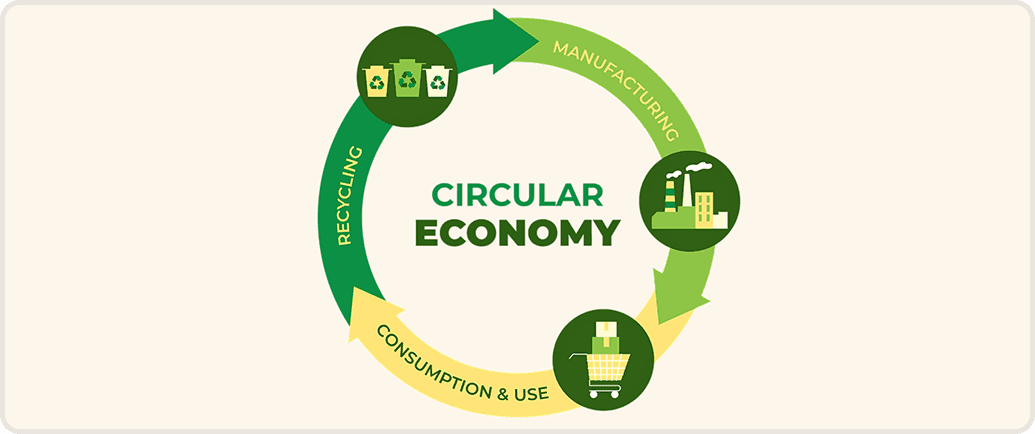
We take resources from the ground to make products, which we use, and when we no longer want them throw them away: take-make-waste. We call this a linear economy. We need to change from this linear model into a Circular Economy. A Circular Economy is an economy that is restorative and regenerative by design.
We must transform every element of our take-make- waste system: how we manage resources, how we make and use products, and what we do with the materials afterwards. Only then can we create a thriving Circular Economy that can benefit everyone within the limits of our planet.
Circular Economy is a powerful model consisting of principles and activities that aim to retain the value of resources, materials, components and products for as long as possible in the economy. It takes a systemic approach to reducing consumption of natural resources and to contributing to sustainable development.
Looking beyond the current take-make-dispose extractive industrial model, a Circular Economy aims to redefine growth, focusing on positive society-wide benefits. It entails gradually decoupling economic activity from the consumption of finite resources and designing waste out of the system. Underpinned by a transition to renewable energy sources, the circular model builds economic, natural, and social capital.
The Circular Economy is based on three principles:
This systemic change offers opportunities not only for the environment, for example by reducing CO2 emissions, but also for companies and households, for example by reducing costs, reducing health-related expenses and creating jobs. The World Resources Institute summarizes the five opportunities of a Circular Economy very simply, as follows:
Ellen MacArthur Foundation calculates the benefits of a Circular Economy like this:
Trends and Frameworks
Key trends, concepts and players
To get you, your team and your partners started, immerse yourself in the ideas, conversations and actors shaping the Circular Economy.
It is important to understand the concepts and terminology in order to facilitate a precise conversation with stakeholders. As a facilitators of Circular Economy ecosystems, ESOs have a responsibility to avoid dilution of the concepts. We facilitate initiatives that may be early stage and under development, but we are also mindful of the actual impact of the initiatives. For example, working with recycled materials is not always a perfect solution. Sometimes in creating a solution for one problem, we unintentionally create a new problem elsewhere, as this blogpost from World Resources Institute illustrates. It can be more energy intensive to recycle materials, and mixing natural materials with plastics creates a future waste problem. This is why it is important to understand the concepts and keep an open and critical mind when assessing ventures or partners.
What follows overleaf is an overview of key concepts and perspectives relating to Circular Economy. The definitions, approach and resources of Ellen MacArthur Foundation (EMF) are at the center of this chapter, but other relevant frameworks are also presented, because these are important too.
Take a look and find what resonates the most with your context. Don’t get lost in complexity and give yourself permission to go slow - this toolkit will help you be pragmatic in how you apply everything to your work.
Now going more deeply into the history, the Circular Economy model synthesizes several major schools of thought, including:
Developments and opportunities in key sectors
The World Economic Forum released this report in 2021 about the opportunities for a Circular Economy in Africa for the African Circular Economy Alliance. According to this report the focus here should be on food systems, packaging, the built environment, electronics, and fashion and textiles.
Be sure to also check out the great overview of Circular Economy case studies by Footprints Africa. Here are more case studies on Scale-Ups leading the way.
For these sectors this toolkit has collected some contextual information, best practices, examples of successful innovations and a list of interesting extra reads from various sources. You will also find a list of strategies that entrepreneurs operating in the given sectors can develop to support a Circular Economy.
Agrifood
The agrifood sector can benefit greatly from a circular perspective, for example:
Het Groene Brein outlined three strategies that many entrepreneurs focus on:
More information on food and the Circular Economy can be found here.
Construction and built environment
The construction sector consumes 42 billion tonnes of resources annually, making it the most material-intensive sector. The construction sector also produces about one-third of all global waste, most of which is not recycled or reused, but ends up in landfills.
Ellen MacArthur Foundation highlights two clear benefits of a circular construction industry:
Here are important circularity topics in the context of construction:
Inspiring examples of keeping track of materials in use in a building are Madaster (a buildings ‘material passport’ in the Netherlands) and platforms providing access to construction leftover materials in the Basque region, Spain, or in Berlin, Germany. In South Africa DigiYard is building the bridge between leftover, recovered or slightly damaged building materials and social building initiatives (for schools or in slums), an intrapreneurial initiative of ARUP in South Africa.
Fashion
Fashion is a major global industry, posing serious sustainability challenges. The numbers in EMF’s 2017 Circular Textiles report are startling:
Clothes are an everyday necessity, and for many an important expression of individuality. Yet the industry’s current take- make-dispose model is the root cause of many environmental impacts and substantial economic value loss. Every second, the equivalent of one garbage truck of textiles is landfilled or burned. An estimated USD 500 billion value is lost every year due to clothing that’s barely worn and rarely recycled. If nothing changes, by 2050 the fashion industry will use up a quarter of the world’s carbon budget. As well as being wasteful, the industry is polluting: clothes release half a million tonnes of microfibres into the ocean every year, equivalent to more than 50 billion plastic bottles. Microfibres are likely impossible to clean up and can enter food chains.
Ellen MacArthur Foundation, A New Textiles Economy
Often people don’t realize that many textiles contain plastics, which is why it is important to use different materials or consciously work with textile waste, separation and reuse.
Circular models include reusing clothes via a sharing platform or post-consumer waste recycling into
virgin yarns (like Loop-a-life for clothes or Reblend for interior design in the Netherlands).
More information about fashion and the Circular Economy can be found here. A specific toolkit for fashion by Circle Economy can be found here including lots of workshop canvasses.
Electronics
In the technical sphere it is easy to see all the steps of the R-ladder, including repair, refurbishment, modular design, design for separation of materials for reuse and recycling, for example FairPhone and Closing the Loop.
Not only phones and computers, but also household appliances are interesting topics and don’t forget about logistics for example with electronic cargo bikes or tuktuks.
While opportunities are everywhere in the manufacturing industry, here are three strategies highlighted by Het Groene Brein on which many entrepreneurs focus:
Waste and plastics
Waste is often described as a design problem, but it is also a problem linked to policies, logistics and markets, such as when waste is being shipped to developing economies.
A complicating factor in working with waste is that it is usually mixes many different materials. While it can be challenging to collect one waste stream and energy-demanding to recycle it, it is even harder to separate waste into pure streams. Take plastics for example. Plastic products are often actually also a mix of various types of plastic materials. Look at Sweepsmart and their waste centers in India and Indonesia as inspiring examples where waste pickers became waste managers.
Plastics can be found in all sectors of the economy; not only in packaging but also in textiles and the agricultural sector for example. Plastics are used
everywhere but the challenges are not spread equally. Some countries export the waste stream, and look at what happened when plastic waste could
no longer be shipped to China. This showed many governments that exporting waste for recycling is not a perfect solution and we need alternative solutions upstream. When we can avoid using plastic, or replace single-use plastic with alternatives, and expand the use-life of plastic products, we make a big win. In many locations waste collection and separation is improved. This is
important to avoid plastic waste leaking into the environment.
Het Groene Brein highlights five strategies upon which many entrepreneurs and administrators are focusing in order to achieve a circular application of plastics:
For more information check out these resources:
Circular business models
An important point about the Circular Economy is that it refers to a totally different economic system. Entrepreneurs and other stakeholders are developing pieces of this new system by trial and error.
Circular business models are different in how they organize value chains or look at ownership structures. Put more simply, one company cannot be a circular business on its own. Companies need a system that facilitates their circular solution and until the entire economy is circular, it can be challenging to collaborate with linear companies and within regulations designed for a linear economy (read about Circular Economy legal challenges in this article about the Netherlands).
Circular business models are based on these five revenue models:
Consider different strategies. For example a venture could create a new business model or facilitate a Business-to-Business collaboration in a certain value chain to increase circularity. A venture could look at packaging and logistics, or at waste stream valorization (one person's waste is another person's resource). A venture could design new products that will have no waste after end-of-use or build a local circular ecosystem.
You can find a detailed overview of how businesses create circular business models here.
Starting a circular value chain versus moving from linear to circular
Working with startups that from day one have had the explicit intent of being a circular solution is very different from working with existing ventures to transform from a linear into a more circular model. SITRA calls them the Circular Natives and the Circular Adapters. Impact Hub Donostia, for example, has focused on the latter - Circular Adapters - with their Oleku program.
As an ESO you can look at the CIRCO training for Small and Medium-sized Enterprises (SMEs), and read Products that last by Conny Bakker.
Circular Natives and Circular Adapters can be valuable to each other, because both have their strengths. The startup with a circular solution at the core of its business model can capitalize on that to create a compelling brand story. This is attractive to a transitioning company (or other organizations) that in turn can offer access to a supply chain or a market. Think of a startup selling circular compost in an agricultural inputs wholesaler or electric logistic vehicles powered by refurbished batteries coming from e-waste.
It is important to note that some ventures you define as Circular Adapters might not necessarily be aware of what circularity is, but may nevertheless be practicing at least some circular principles already.
For more inspiration on moving from linear to circular, you can also look at these circular service business models.
Financing circular business models
In general, funding is available in the form of participations, loans or public funding.
The right type of financing depends on circumstances such as the type of circular business model and the development phase of the organization.
Attracting funding for a new initiative is challenging as it will be perceived as riskier without a track record.
Circular business models have a different risk and return profile than current linear models. Companies and financiers will take this into account. There are important differences in the change in financial flows, the dependence on partners and customers, and the complexity of risks. In the case of circular startups this can be even more complicated when looking at Product-as-a-Service (access instead of ownership, like a car sharing membership, meaning a lot of assets on the balance sheet) or Pay-Per-Use (spreading payments over a long period of time, thus impacting on the cash flow).
For more information about the risks of financing circular businesses, check out:
There are many potential funding partners to consider for entrepreneur support programs engaging in Circular Economy: